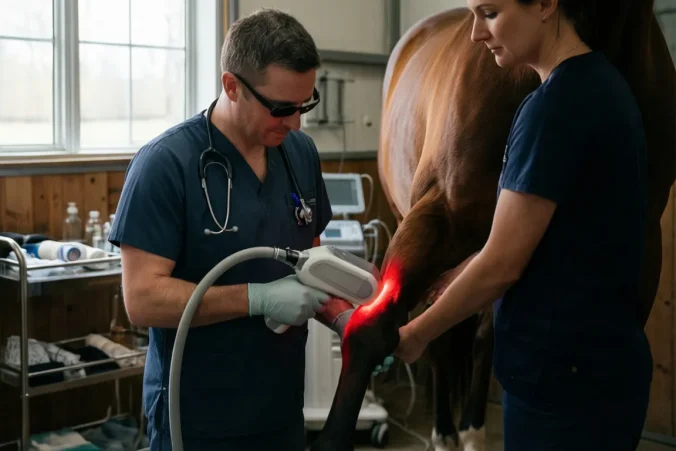
Laser Therapy and Regenerative Medicine in Equine Practice: Current Evidence
You see these tools showing up more often in lameness exams. The current evidence gives clearest support for laser on superficial tendon and ligament lesions when you pair it with controlled exercise. Regenerative options like PRP add value mainly in cases with core lesions or poor fiber alignment on ultrasound.
Where the Data Stands Right Now
Most published work focuses on Class 3b and 4 lasers at 5-15 J/cm². Studies report reduced swelling and faster return to light work in superficial digital flexor tendonitis, but controlled trials remain small. PRP shows moderate improvement in fiber pattern scores at 30-60 days when injected under ultrasound guidance. Stem cell data stays more mixed and case dependent.
- Acute tendon strain in a 5-year-old eventer: two laser sessions per week for three weeks plus hand walking produced visible echogenicity gains by day 21.
- Chronic suspensory branch desmitis: single ultrasound-guided PRP injection followed by laser every 10 days yielded better long-term fiber scores than laser alone in one practice cohort.
Practical Laser Settings That Match the Evidence
Start with the lesion size on ultrasound rather than a fixed protocol. Scan first, mark the area, then treat.
- 10-12 J/cm² over the lesion and 2 cm margins, continuous wave, 3-5 minutes per site.
- Repeat three times weekly for the first two weeks, then drop to twice weekly while you increase turnout.
- Re-scan at 21 days. If fiber alignment has improved at least one grade, shift to once-weekly maintenance.
Owners usually notice less heat and filling after the third or fourth treatment. Skip the laser on open wounds or active infection.
Pairing Laser With Regenerative Injections
Timing matters more than volume. Most practitioners inject first, then begin laser 48-72 hours later once the initial inflammatory spike settles.
| Case Type | Regenerative Choice | Laser Start | Follow-up Scan |
|---|---|---|---|
| Core lesion >15% cross-section | PRP or BMAC | Day 3 | Day 30 and 60 |
| Diffuse fiber pattern loss | PRP only | Day 2 | Day 21 |
| Recheck after failed rehab | Consider stem cells | Day 4 | Day 45 |
You will usually see the biggest additive effect in horses that had already plateaued on exercise alone.
Simple Tracking You Can Run in the Field
Keep a one-page sheet per horse. Record:
- Ultrasound grade at day 0, 21, and 45
- Days to return to ridden work
- Owner-reported heat or swelling score (0-3) at each visit
- Any setbacks or extra rest days needed
After ten similar cases you will know whether your laser protocol is actually moving the needle on healing times. Adjust energy or frequency only when the numbers tell you to.
Leave a Reply