Nutritional Strategies to Boost Immunity in Transported Livestock
You can raise resistance to stress and illness by changing what and when animals eat in the days right before a haul. The steps below work for cattle, sheep, and goats on trips that last six hours or more.
Start Feed Changes Three Days Out
Begin adjustments early so rumen bugs have time to adapt. Skip last-minute big shifts that can drop intake.
- Raise vitamin E to 400 to 600 IU per head daily for cattle.
- Add 0.3 percent zinc from an organic source in the total mixed ration.
- Keep forage quality steady and avoid sudden grain increases that cause loose manure.
Key Nutrients and Daily Targets
These four items give the clearest payoff during transport stress.
| Nutrient | Target per head | Example for 500 kg steer |
|---|---|---|
| Vitamin E | 500 IU | Top-dress 5 g of 50 percent E premix |
| Zinc | 30 to 40 mg/kg DM | Include chelated zinc in mineral pack |
| Vitamin A | 50,000 IU | Use in the same premix |
| Selenium | 0.3 mg/kg DM | Blend with salt at 90 ppm |
Load-Day Electrolyte Checklist
- Weigh or estimate total body weight of the group.
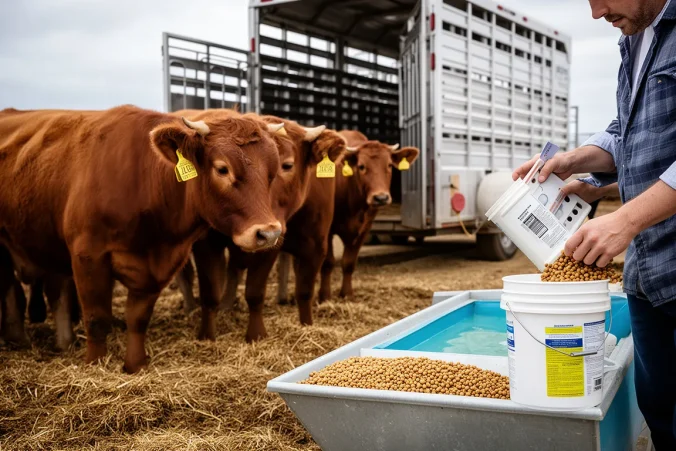
- Mix electrolyte powder at 2 g per kg body weight into 10 liters of water per animal.
- Offer the mix 45 minutes before loading; most cattle drink 4 to 6 liters.
- Skip if animals already have free-choice water and salt.
Handle Transit with Simple Additions
Once animals are on the truck, water access and small feed top-ups matter most. On trips over eight hours, stop every four to six hours and let them drink. Add a probiotic paste at the first stop for groups that look tight in the gut. One 10 g dose per head of a multi-strain product is enough for most 400 kg animals.
Recovery After Unloading
Give animals access to long-stem hay within 30 minutes of arrival. Hold off on heavy grain for the first 12 hours so they can rehydrate. Check manure consistency the next morning; if it is still firm after 24 hours, add another round of electrolytes in the water tank.